



How to Check Engine Mileage on a Used Engine — Step by Step
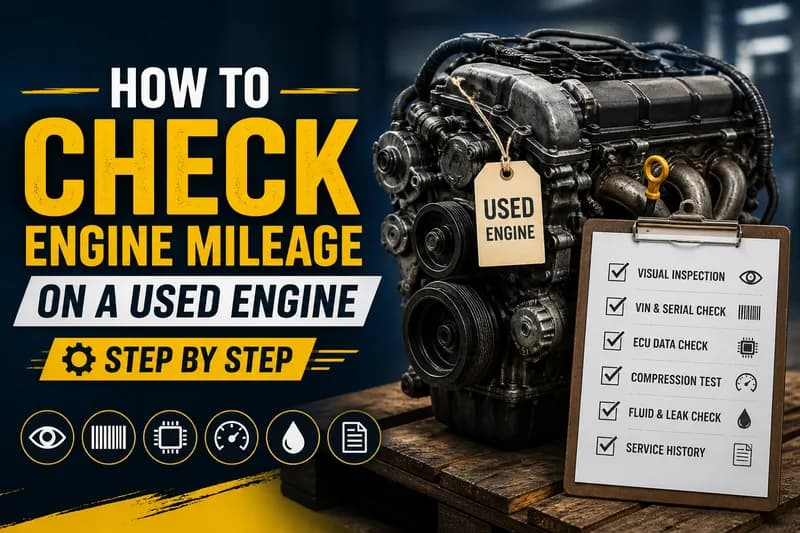
Buying a used engine without verifying its mileage is one of the most common and expensive mistakes vehicle owners make. A seller can write any number on a listing. Your job as a buyer is to confirm it before money changes hands. Here is exactly how to check engine mileage the right way — step by step.
Step 1 — Ask for the Donor Vehicle's VIN
The engine itself has no odometer. The mileage you see on any used engine listing comes from the donor vehicle it was pulled from. The only way to verify that number is to trace it back to the source vehicle using its 17-digit VIN.
Ask the seller directly for the donor vehicle's VIN before anything else. A trustworthy salvage yard or used engine supplier will have this on file and share it without hesitation. Any seller who refuses to provide a donor VIN is giving you a reason to walk away immediately.
Step 2 — Run a Vehicle History Report
Once you have the donor VIN, run it through a vehicle history service. CARFAX and Turbo Autoparts are the two most widely used options in the United States. Both pull odometer readings from every recorded service visit, insurance claim, inspection, and title transfer the vehicle went through.
Look for consistency across all recorded readings. If a vehicle shows 42,000 miles at its last service record and the seller claims the engine has 44,000 miles, that lines up correctly. If the records show 90,000 miles at the last entry and the seller quotes 55,000 miles, that gap is a serious red flag worth questioning before you proceed.
Step 3 — Request a Compression Test Report
A compression test is the physical equivalent of a mileage check. It measures pressure inside each cylinder and gives you direct evidence of internal engine wear, something no document can fake.
A healthy used engine typically shows compression readings between 170 and 210 PSI across all cylinders, depending on the engine family. Consistent readings across all cylinders indicate healthy rings and valve seats regardless of mileage. A cylinder reading 30 PSI lower than the others signals internal wear that the mileage figure alone never reveals.
Any reputable used engine for sale supplier performs and documents compression testing before listing. Ask for the printed results before committing to a purchase.
Step 4 — Inspect the Physical Condition
Physical inspection backs up everything the paperwork tells you. A genuinely low-mileage engine shows specific characteristics that high-mileage units cannot fake.
Remove the oil filler cap and look inside. A low-mileage, well-maintained engine shows clean amber-colored oil residue with minimal buildup. Thick dark sludge coating the interior surfaces tells you the engine ran long intervals between oil changes regardless of what the mileage record says.
Check the valve cover gasket area for seepage and the timing cover for oil staining. Examine the block for corrosion cracks and physical damage. Look at the condition of the accessory brackets and exhaust manifold bolts; heavy surface rust on these components indicates age and high accumulated mileage far more honestly than any seller's claim.
Step 5 — Cross-Reference the Engine Serial Number
Every engine carries a stamped serial number on the block. Some manufacturers allow you to cross-reference this serial number against production records to confirm the engine's origin and verify it matches the donor VIN the seller provided.
Call the manufacturer's customer support line with the serial number and donor VIN together. Not every brand maintains accessible public records, but Ford, Toyota, and GM have historically assisted buyers with this verification when contacted directly. This step adds a final layer of confirmation that the engine you are buying is exactly what the seller represents it to be.
Final Word
Checking engine mileage is not a single step. It is a process that combines document verification, physical inspection, and compression testing together. Any one of these methods alone leaves gaps. All three together give you a reliable picture of what you are actually buying.
Click on Turbo Auto Parts, Every used engine listing includes verified donor vehicle mileage, a grade A compression test report, and full VIN-based fitment confirmation before shipment. Get documentation on any engine in our inventory before you order.