



What Is Engine Mileage History — And Why It Can Save You
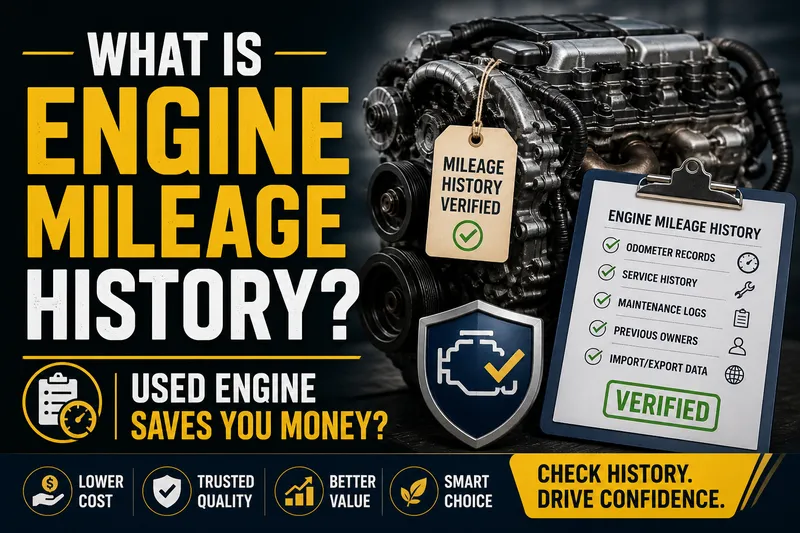
Most people shopping for a used engine ask one question first. How many miles does it have? That is a fair starting point. But experienced mechanics and smart buyers know that mileage alone tells only half the story. Engine mileage history is the full picture where those miles came from, how they were accumulated, and whether the number you see on a listing actually reflects the true condition of the unit inside the box.
Getting this wrong is expensive. A used engine that looks clean on paper but carries a hidden story of abuse, neglect, or odometer manipulation can fail within months of installation. Understanding what engine mileage history really means before you hand over your money is one of the most valuable things you can do as a buyer.
What Does Engine Mileage History Actually Mean
Engine mileage history is not just a number. It is the documented record of how many miles that specific engine accumulated inside its original donor vehicle before being pulled for resale. This includes the last recorded odometer reading on the donor vehicle title, the service history attached to that vehicle, and any available maintenance records showing how regularly the oil was changed and whether the engine was properly maintained throughout its life.
The key word here is documented. Any seller can claim an engine has 45,000 miles on it. A seller with actual engine mileage history can prove it, With a title copy, a vehicle history report, or verifiable salvage yard records tied to the donor vehicle's VIN.
Why Engine Mileage History Is Different From Your Car's Odometer Reading
Here is something most buyers do not realize. When an engine is pulled from a donor vehicle and sold separately, the odometer history stays with the vehicle, not the engine. There is no physical counter on the engine block that you can read the way you read a fuel gauge.
This means how to check engine mileage on a used engine requires you to trace it back to the source. The most reliable method is using the donor vehicle's VIN to pull a vehicle history report through services like CARFAX or AutoCheck. That report shows every recorded odometer reading from every service visit, inspection, and title transfer the vehicle went through. If the mileage figures are consistent across multiple years, the number the seller quotes you is likely accurate. If the records jump around or show suspicious gaps, that is a signal worth investigating before you commit.
How to Verify Used Engine Mileage History Before You Buy
Start by asking the seller for the donor vehicle's VIN. A reputable salvage yard or used engine supplier should have this information on file and should share it without hesitation. Run that VIN through a history report service and compare the last recorded odometer reading against what the seller claims.
Next ask for a compression test report. Used engine mileage verification through a document is important but a compression test gives you physical evidence of internal wear. A healthy engine regardless of mileage should show consistent cylinder pressure readings. Significant variance between cylinders tells you that the engine has internal wear that the mileage figure alone would never reveal.
Also check the engine service records if available. Oil change history is the single most important maintenance factor in engine longevity. An engine with 80,000 miles and consistent oil changes every 5,000 miles will outperform a 50,000-mile engine that went 15,000 miles between oil changes every time.
How Many Miles Is Too Many on a Used Engine
This question comes up constantly, and the answer depends on the engine family and how those miles were driven. As a general guide, most mechanics consider used engines under 80,000 miles from documented low-mileage donors to be strong purchases. Engines between 80,000 and 120,000 miles are acceptable when service records are clean and compression tests pass. Engines over 120,000 miles carry higher risk and should only be purchased with significant warranty coverage and a thorough inspection report.
Japanese domestic market engines — commonly called JDM units — are a popular exception to this rule. Japan's strict vehicle inspection system causes owners to retire cars well before 60,000 miles, which means JDM engines regularly enter the used market with genuinely low mileage verified by Japanese title documentation.
5 Signs a Used Engine Has More Miles Than the Seller Claims
Knowing what to look for physically gives you a second layer of protection beyond the paperwork.
Heavy oil sludge visible around the valve cover and oil filler cap is the clearest sign of a high-mileage neglected engine. Fresh oil in a low-mileage engine leaves minimal residue. Thick dark sludge means the oil was changed infrequently over a long period.
Worn timing chain tensioners produce a rattling sound on startup that disappears after a few seconds of running. This sound is almost always a high-mileage indicator on engines like the Ford 5.4L Triton and GM 5.3L Vortec.
Scored cylinder walls visible through the spark plug holes with a borescope camera show piston ring wear consistent with high-mileage operation. A low-mileage engine should show a clean crosshatch pattern on the cylinder wall.
Excessive carbon buildup on the intake valves on direct-injection engines indicates long intervals between oil changes over many thousands of miles.
Corrosion on external engine components, including the alternator bracket, water pump housing, and exhaust manifold bolts, suggests the engine sat exposed or operated in harsh conditions for an extended period.
Why Low Mileage Alone Does Not Guarantee a Good Used Engine
A 30,000-mile engine sounds ideal on paper. But mileage means very little if those 30,000 miles came from a vehicle that sat for three years between uses ran consistently low on oil or operated in extreme heat without proper cooling system maintenance.
Used engine reliability by mileage is always conditional on how those miles were driven and how the engine was maintained along the way. A 70,000-mile engine from a fleet vehicle with documented quarterly oil changes and consistent highway driving will almost always outlast a 25,000-mile engine from a neglected city car where the oil was changed twice in four years.
This is why the best used engine suppliers combine mileage documentation with physical inspection results rather than relying on either one alone.
What a Responsible Supplier Verifies Before Every Engine Sale
At Turbo Auto Parts every used engine mileage history claim is backed by documentation tied to the donor vehicle's records. Our technicians perform a cylinder-by-cylinder compression test on every unit scan for stored OBD-II fault codes, check oil condition for sludge and contamination, and physically inspect the block, head, and all sealing surfaces before any engine earns a Grade A listing.
We also perform a VIN-based fitment check on every order before shipment—confirming that the engine's configuration matches your vehicle's exact specification, including drivetrain emissions calibration and sensor layout.
Every engine we sell ships with a 3-Year / 30,000-Mile warranty included in the purchase price. Free freight shipping applies to all commercial addresses nationwide. No core charge applies to any order.
If you have questions about a specific engine's mileage history or want to verify fitment before ordering call our team at (888) 777-0769 Monday through Friday 9 AM to 7 PM CST. We pull the documentation and walk you through it before you spend a dollar.