
How to Check If a Replacement Engine Is Compatible With Your Vehicle

How to Check If a Replacement Engine Is Compatible With Your Vehicle
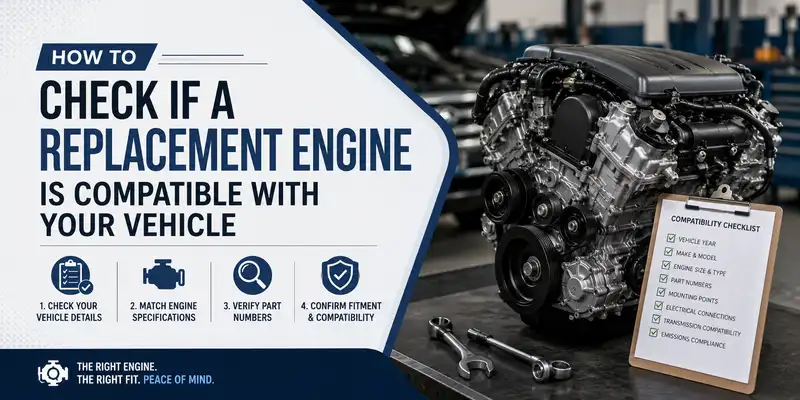
Author : Harshit
Published : 29 June 2026

When your engine fails, the clock starts ticking. You need a replacement that fits, runs reliably, and gets you back on the road without unnecessary delays. But here's the part many drivers overlook: not every engine that "matches your make and model" will actually work in your vehicle. Engine compatibility depends on much more than the badge on your trunk.

Order the wrong engine, and you could end up dealing with shipping delays, return hassles, or an installation that simply doesn't work. The good news is that checking compatibility isn't complicated once you know what to look for.

In this guide, we'll walk through every factor that determines whether a replacement engine is truly compatible with your vehicle, and how Turbo Auto Parts makes verification easier with VIN-based search tools and detailed listings.

Why Engine Compatibility Is More Complicated Than Make and Model

It's tempting to think any engine from the same make, model, and year will be a guaranteed fit. In reality, manufacturers frequently offered multiple engine options for the exact same model year, and even visually similar engines can differ in displacement, fuel delivery system, emissions equipment, and electronic controls.

Two vehicles sitting side by side on a dealership lot, same year and trim, could have completely different engines under the hood depending on options selected at purchase. That's exactly why compatibility checks matter before buying a replacement engine online.

Pull Your Vehicle Identification Number (VIN)

Your VIN is the single most reliable tool for confirming engine compatibility. Encoded within those 17 characters is information about your vehicle's engine size, fuel type, and sometimes the specific engine variant installed at the factory. You'll typically find your VIN on the driver's side dashboard (visible through the windshield), on a sticker inside the driver's side door jamb, or on your registration, insurance card, or title.

When shopping for a replacement engine, always have your VIN ready. Reputable sellers, including Turbo Auto Parts, use VIN information to confirm an exact match before your order ships, significantly reducing the risk of receiving an incompatible part.

Confirm the Engine Code

Beyond the VIN, most vehicles have a specific engine code stamped on the engine block or listed on an under-hood sticker. This code identifies the exact engine family and variant, which matters most for vehicles where multiple engine options were available in the same model year. Your owner's manual or a quick call to a dealership parts department can usually point you to it. Having this code ready when you shop makes it much easier to confirm compatibility before placing your order.

Match Displacement and Cylinder Configuration

Engine displacement, measured in liters, and cylinder configuration (such as 4-cylinder, V6, or V8) need to match exactly. Even a small difference, like a 2.0L versus a 2.4L version of what otherwise looks like the same engine family, can mean the replacement won't bolt up correctly or won't perform the way your vehicle was designed to.

Always cross-reference displacement and cylinder count listed on a replacement engine against your vehicle's original specifications, which you can usually find using your VIN or engine code.

Check Fuel System and Emissions Equipment

Modern engines often come in multiple configurations depending on regional emissions requirements or fuel delivery systems, such as direct injection versus traditional fuel injection. An engine pulled from a vehicle built for a different emissions standard may not integrate properly with your wiring harness and onboard computer systems. This is one of the more overlooked compatibility factors, which is why a knowledgeable seller who can confirm these details against your VIN is so valuable.

Verify Transmission and Drivetrain Pairing

The engine and transmission also need to be compatible with each other, particularly the bell housing pattern, sensor placement, and computer programming that lets them communicate. If you're replacing the engine but keeping your existing transmission, confirm the replacement engine is documented as compatible with your specific transmission and drivetrain (FWD, RWD, AWD, or 4WD).

Confirm Wiring Harness and Computer Compatibility

Many newer engines rely on the vehicle's onboard computer to manage fuel delivery, ignition timing, and emissions controls. A replacement engine from a different trim or model year might use a different wiring harness or engine control unit (ECU), which can create issues even if the engine itself is mechanically identical. Ask whether the wiring harness and ECU from the donor vehicle are included, and confirm whether reprogramming will be needed.

Check Mileage and Part Grade

Once you've confirmed mechanical and electronic compatibility, mileage and overall condition help you decide between multiple compatible options. A lower-mileage engine with documented testing is generally the safer choice. Reputable sellers grade their inventory so you can compare options at a glance. Turbo Auto Parts lists mileage and part grade directly on every engine listing, making it easy to compare multiple compatible units side by side.

Confirm Warranty Coverage

Even with careful compatibility checks, a warranty gives you protection if an unexpected issue comes up after installation. Always confirm the warranty length and terms before finalizing your purchase. Turbo Auto Parts backs its used and remanufactured engines with a 3-year or 30,000-mile warranty, whichever comes first, so you're covered if something doesn't go as expected.

Common Compatibility Mistakes to Avoid

  • Assuming make, model, and year are enough. Multiple engine variants are often available within the same model year.
  • Overlooking emissions and fuel system differences. These can prevent proper integration even when displacement matches.
  • Forgetting to check the transmission pairing. Mechanical fit and electronic compatibility both matter.
  • Skipping the wiring harness and ECU question. This is one of the most common causes of post-installation issues.
  • Buying without a VIN check. Skipping this step is the single biggest risk factor when shopping for a replacement engine.

How Turbo Auto Parts Simplifies Engine Compatibility Checks

Verifying compatibility shouldn't require a mechanical engineering degree, and that's exactly the problem Turbo Auto Parts set out to solve. Here's how the process is made easier:

  • VIN-based search and verification, helping confirm the exact engine match for your vehicle before you order
  • Detailed listings showing mileage, part grade, displacement, and configuration details
  • 3-Year / 30,000-Mile Warranty on qualifying used and remanufactured engines
  • Free shipping to commercial addresses nationwide, plus a fast 15-day shipping option for urgent orders
  • Financing available, so a major repair doesn't have to be paid for all at once
  • Coverage for 40+ makes, from common brands like Ford, Chevy, Honda, and Toyota to specialty makes like BMW, Mercedes-Benz, and Land Rover
  • Knowledgeable support team, available by phone at +1 (888) 618-8881, Monday through Friday, 9 AM to 7 PM, ready to confirm compatibility before your order ships

Whether you're repairing a daily driver or a work vehicle that can't sit idle for long, having access to detailed compatibility information and real support makes it far easier to get the right engine on the first try.

Final Thoughts

Checking engine compatibility comes down to a handful of critical details: VIN and engine code, displacement and cylinder configuration, fuel and emissions systems, transmission pairing, and wiring harness compatibility. Skipping any one of these steps increases the risk of ending up with a part that doesn't fit or doesn't perform the way it should.

Taking the time to verify these details before you buy, and working with a seller who backs its parts with a real warranty, is the most reliable way to get your vehicle back on the road without unnecessary setbacks.

How do I know if a replacement engine will fit my car?

The most reliable way is to confirm your VIN and engine code, then cross-reference displacement, cylinder configuration, and fuel system details against the replacement engine's specifications.

Can two vehicles of the same make, model, and year have different engines?

Yes. Manufacturers often offer multiple engine options for the same model year, which is why VIN and engine code verification matters more than make and model alone.

Does a replacement engine come with the wiring harness?

This varies by seller and listing. Always ask whether the wiring harness and ECU are included, since mismatched electronics can prevent proper engine integration.

How much can I save by buying a used or remanufactured engine instead of new?

Many buyers save 40% to 60% compared to the cost of a brand-new factory engine, depending on the make, model, and engine type.

Does Turbo Auto Parts offer a warranty on replacement engines?

Yes. Turbo Auto Parts backs its used and remanufactured engines with a 3-year or 30,000-mile warranty, whichever comes first.

Can I install a replacement engine myself?

Some experienced DIYers handle engine swaps at home, but most drivers should use a certified mechanic, especially on newer vehicles with complex electronics and emissions systems.

Does Turbo Auto Parts ship engines nationwide?

Yes. Turbo Auto Parts offers free shipping to commercial addresses across the United States, along with a fast 15-day shipping option for time-sensitive orders.