



Top 10 Hyundai Models with the Most Reliable Engine
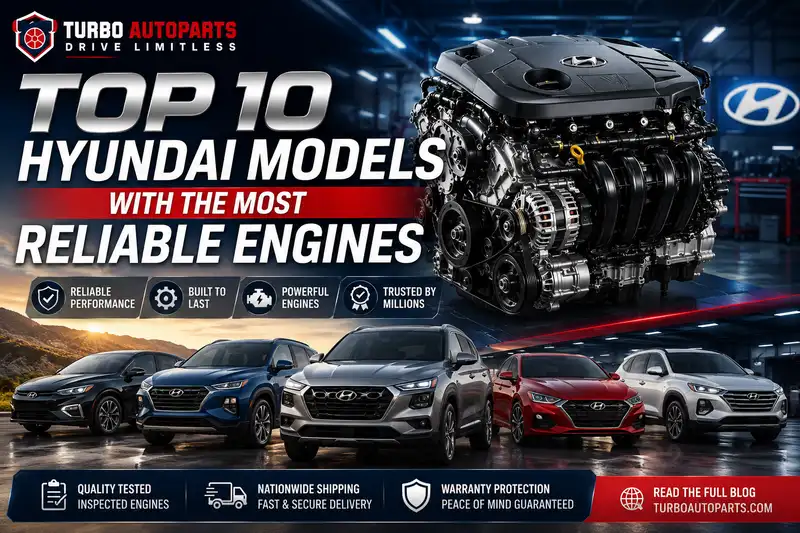
Hyundai has transformed its reputation over the past two decades by developing engines that deliver impressive reliability, efficiency, and long-term value. Modern Hyundai vehicles combine advanced engineering with lower maintenance costs, making them attractive for daily drivers, families, and commuters alike. Engine families such as Gamma, Nu, Lambda, Smartstream, and selected Theta II variants have powered millions of vehicles worldwide. Whether you own an Elantra, Sonata, Tucson, Santa Fe, or Palisade, understanding engine reliability helps you make informed maintenance and replacement decisions. This guide explores the ten Hyundai models with the most dependable engines while highlighting engine sizes, production years, common strengths, and ownership insights.
How We Ranked Hyundai Engine Reliability
Hyundai Engine reliability depends on more than mileage alone. This ranking considers owner satisfaction, maintenance frequency, durability, repair history, fuel efficiency, parts availability, and long-term operating costs. Engines with consistent performance beyond 200,000 miles received higher rankings, while engines affected by widespread recalls or recurring failures ranked lower. Regular maintenance remains the most important factor in extending engine life regardless of engine family.1. Hyundai Elantra – A Benchmark for Everyday Reliability
The Hyundai Elantra has earned a strong reputation for dependable performance and affordable ownership. Earlier models featured the reliable 1.8L Nu MPI engine, while later versions introduced the efficient 2.0L Nu and Smartstream engines.
Popular engine applications include:
- 2011 Hyundai Elantra – 1.8L Inline-4
- 2012 Hyundai Elantra – 1.8L Inline-4
- 2013 Hyundai Elantra – 1.8L Inline-4
- 2014 Hyundai Elantra engine – 1.8L and 2.0L
- 2015 Hyundai Elantra – 1.8L
- 2017 Hyundai Elantra – 2.0L Nu
- 2020 Hyundai Elantra – 2.0L Smartstream
The Nu engine delivers smooth power, respectable fuel economy, and relatively low maintenance costs. Regular oil changes and cooling system inspections significantly improve engine longevity. Many well-maintained Elantras exceed 200,000 miles without major internal engine repairs.
2. Hyundai Sonata – Comfortable Sedan with Proven Powertrains
The Hyundai Sonata combines comfort with a diverse range of engines. While some Theta II engines experienced well-publicized issues, properly maintained later engines provide dependable long-term performance. The introduction of Smartstream technology further improved efficiency and durability.
Common engine options include:
- 2011 Hyundai Sonata – 2.4L Theta II
- 2013 Hyundai Sonata – 2.4L GDI
- 2015 Hyundai Sonata – 2.4L
- 2018 Hyundai Sonata – 2.4L
- 2020 Hyundai Sonata – 2.5L Smartstream
The Smartstream engine delivers smoother operation, lower emissions, and improved fuel economy compared with earlier generations. Buyers should always verify recall history before purchasing older Sonata models equipped with Theta II engines.
3. Hyundai Santa Fe – Reliable SUV for Families
The Hyundai Santa Fe remains one of Hyundai's most dependable SUVs. Earlier models offered durable naturally aspirated engines, while newer versions introduced turbocharged Smartstream technology. The Lambda V6 engines continue to receive praise for smooth operation and towing performance.
Popular engine combinations include:
- 2010 Hyundai Santa Fe – 2.4L Inline-4
- 2012 Hyundai Santa Fe – 3.5L V6
- 2017 Hyundai Santa Fe – 3.3L Lambda V6
- 2019 Hyundai Santa Fe – 2.4L GDI
- 2021 Hyundai Santa Fe – 2.5L Turbo Smartstream
Routine maintenance of the cooling system, ignition components, and timing systems helps these engines deliver dependable long-term performance.
4. Hyundai Tucson – Compact SUV with Excellent Engine Longevity
The Tucson has become one of Hyundai's best-selling SUVs because it balances efficiency, practicality, and dependable engineering. Its naturally aspirated engines generally require less maintenance than many turbocharged competitors.
Notable Hyundai Tucson engine options include:
- 2012 Hyundai Tucson – 2.0L MPI
- 2014 Hyundai Tucson – 2.4L GDI
- 2017 Hyundai Tucson – 2.0L Nu
- 2022 Hyundai Tucson – 2.5L Smartstream
Proper maintenance, including regular coolant replacement and scheduled oil services, allows many Tucson engines to exceed 200,000 miles while maintaining consistent performance.
5. Hyundai Accent – Small Engine, Exceptional Durability
The Hyundai Accent demonstrates that smaller engines can provide excellent long-term reliability. Its Gamma engine family combines fuel efficiency with simple mechanical design, making it one of Hyundai's most dependable compact cars.
Common engine applications include:
- 2012 Hyundai Accent – 1.6L Gamma
- 2014 Hyundai Accent – 1.6L Gamma
- 2016 Hyundai Accent – 1.6L Gamma GDI
- 2020 Hyundai Accent – 1.6L Smartstream
These engines require relatively little maintenance beyond routine oil changes, spark plug replacement, and cooling system servicing. Their lightweight design contributes to excellent fuel economy while maintaining dependable everyday performance.
6. Hyundai Genesis & Genesis Coupe – Performance Meets Reliability
Before Genesis became a standalone luxury brand, Hyundai introduced the Genesis Sedan and Genesis Coupe with engines that balanced refinement and strong performance. The naturally aspirated Lambda V6 remains one of Hyundai's most respected powerplants because of its durability and smooth power delivery.
Popular engine configurations include:
- 2009 Hyundai Genesis – 3.8L Lambda V6
- 2012 Hyundai Genesis – 3.8L V6 and 5.0L Tau V8
- 2015 Hyundai Genesis – 3.8L GDI V6
- 2010 Genesis Coupe – 2.0L Turbo
- 2013 Genesis Coupe – 3.8L Lambda V6
The 3.8L Lambda engine is capable of exceeding 200,000 miles with regular maintenance. Owners should inspect ignition coils, cooling components, and oil seals periodically to maintain peak performance.
7. Hyundai Kona – Modern Smartstream Technology
The Hyundai Kona quickly became one of Hyundai's most successful crossover SUVs. Buyers can choose naturally aspirated, turbocharged, hybrid, and electric powertrains depending on the model year.
Common engine options include:
- 2018 Hyundai Kona – 2.0L Nu MPI
- 2020 Hyundai Kona – 1.6L Turbo Gamma
- 2022 Hyundai Kona – 2.0L Smartstream
- 2024 Hyundai Kona – 2.0L Smartstream and Hybrid
The naturally aspirated 2.0L engine delivers dependable daily performance, while the 1.6L turbo provides stronger acceleration for drivers seeking additional power.
8. Hyundai Palisade – One of Hyundai's Best V6 SUVs
The Hyundai Palisade has become one of Hyundai's flagship family SUVs. Every model uses the dependable 3.8-liter Lambda II V6, known for its smooth operation and impressive towing capability.
Popular models include:
- 2020 Hyundai Palisade – 3.8L V6
- 2021 Hyundai Palisade – 3.8L V6
- 2022 Hyundai Palisade – 3.8L V6
- 2023 Hyundai Palisade – 3.8L V6
The Lambda II engine combines direct injection with modern engine management systems to provide dependable performance while requiring relatively straightforward maintenance.
9. Hyundai Veloster – Reliable Compact Performance
The Hyundai Veloster offers sporty styling without sacrificing everyday reliability. Its Gamma engine family has proven dependable when owners follow recommended maintenance intervals.
Notable engine options include:
- 2012 Hyundai Veloster – 1.6L Gamma
- 2015 Hyundai Veloster Turbo – 1.6L Turbo
- 2019 Hyundai Veloster N – 2.0L Turbo
Routine oil changes, spark plug replacement, and turbocharger inspections help maximize engine life, particularly for turbocharged models driven aggressively.
10. Hyundai Ioniq – Efficient Hybrid Engineering
The Hyundai Ioniq demonstrates Hyundai's advancement in hybrid technology. These vehicles combine efficient gasoline engines with electric motors to reduce fuel consumption while maintaining dependable reliability.
Popular configurations include:
- 2017 Hyundai Ioniq Hybrid – 1.6L GDI Hybrid
- 2020 Hyundai Ioniq – 1.6L Hybrid
- 2022 Hyundai Ioniq 5 – Fully Electric
- 2023 Hyundai Ioniq 6 – Fully Electric
The hybrid system requires little additional maintenance beyond standard engine servicing and battery inspections, making it an attractive choice for long-term ownership.
Which Hyundai Engine Is the Most Reliable?
Several Hyundai engines consistently receive positive feedback from mechanics and long-term owners.
| Engine Family | Common Engine Size | Popular Models | Reliability |
|---|---|---|---|
| Gamma | 1.6L | Accent, Veloster | Excellent |
| Nu | 1.8L / 2.0L | Elantra, Tucson | Excellent |
| Lambda II | 3.3L / 3.8L | Santa Fe, Palisade, Genesis | Excellent |
| Smartstream | 2.0L / 2.5L | Sonata, Tucson, Kona | Very Good |
| R-Series Diesel | 2.2L | Santa Fe, Starex | Very Good |
Each engine family performs best when owners follow factory maintenance schedules and use quality replacement parts.
Tips to Extend the Life of Your Hyundai Engine
Proper maintenance significantly increases engine longevity and helps prevent expensive repairs.
- Change engine oil and filters at recommended intervals.
- Monitor coolant levels and inspect the cooling system regularly.
- Replace spark plugs according to Hyundai's maintenance schedule.
- Use the correct engine oil recommended by Hyundai.
- Inspect belts, hoses, and gaskets during routine servicing.
- Address warning lights immediately to prevent further engine damage.
- Clean fuel injectors periodically on direct-injection engines.
- Follow scheduled transmission maintenance for improved drivetrain reliability.
Consistent preventive maintenance often allows Hyundai engines to exceed 200,000 miles while maintaining dependable performance.
Final Thoughts
Hyundai has made remarkable progress in engine development during the past twenty years. Engine families such as the Gamma, Nu, Lambda II, and Smartstream have helped establish Hyundai as a manufacturer known for dependable and efficient powertrains. Models like the Hyundai Elantra, Sonata, Santa Fe, Tucson, Accent, Genesis, Kona, Palisade, Veloster, and Ioniq continue to demonstrate that proper maintenance plays a greater role in reliability than mileage alone. Understanding engine specifications, production years, and compatibility helps owners make informed decisions when maintaining or replacing a Hyundai engine.
Find Quality Hyundai Engines at Turbo Auto Parts
If your Hyundai engine has reached the end of its service life, selecting a properly matched replacement is essential for restoring factory performance and reliability. At Turbo Auto Parts, we supply quality-tested used Hyundai engines for a wide range of models, including the Elantra, Sonata, Santa Fe, Tucson, Accent, Genesis, Kona, Palisade, Veloster, Ioniq, and many more. Our inventory includes popular engine options such as the 1.6L Gamma, 1.8L Nu, 2.0L Nu, 2.4L Theta II, 2.5L Smartstream, 3.3L Lambda, and 3.8L Lambda II engines.
Every replacement engine undergoes quality inspection before shipment and is backed by a 3-Year/30,000-Mile Warranty for added peace of mind. We also provide free shipping to commercial addresses anywhere in the USA and never charge extra core fees, helping customers avoid unnecessary replacement costs. Whether you need an engine for a daily commuter, family SUV, or performance-oriented Hyundai model, choosing the correct engine specification and compatibility remains the most important step toward dependable long-term ownership.
Frequently Asked Questions
1. Which Hyundai engine is considered the most reliable?
The Gamma 1.6L, Nu 2.0L, and Lambda II 3.8L engines are widely recognized for their durability, efficiency, and long service life.
2. How long do Hyundai engines typically last?
With regular maintenance, many Hyundai engines can operate reliably for 200,000 to 300,000 miles before requiring major repairs.
3. Which Hyundai SUV has the most reliable engine?
The Hyundai Palisade, Santa Fe, and Tucson consistently rank among Hyundai's most reliable SUVs due to their proven engine platforms.
4. Is the Hyundai Smartstream engine reliable?
Yes. Smartstream engines feature updated engineering, improved fuel efficiency, and enhanced durability when maintained according to factory guidelines.
5. Which Hyundai engine family should I choose?
The best engine depends on your driving needs. The Gamma engine suits commuters, while the Lambda II V6 offers stronger performance for larger SUVs.
6. Are all Hyundai Theta II engines unreliable?
No. Although certain Theta II engines experienced recalls, many later models perform reliably after manufacturer improvements and proper maintenance.
7. Which Hyundai model is best for long-term ownership?
The Elantra, Tucson, Santa Fe, and Palisade consistently receive high reliability ratings and remain dependable choices for long-term ownership.
8. How can I identify the correct Hyundai engine for my vehicle?
Verify the VIN, engine code, production year, transmission type, and emissions specifications before selecting a replacement engine or ordering parts.