



How to Find the Right Used Transmission for Your Vehicle
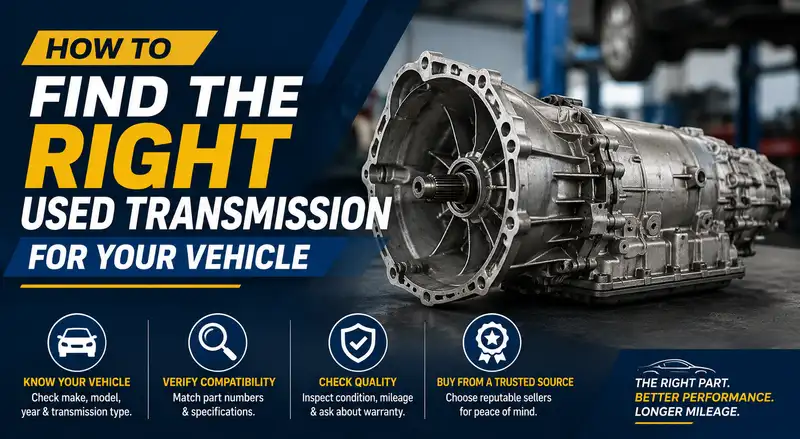
A failing transmission is one of those problems you can't ignore for long. Slipping gears, delayed engagement, strange noises, or fluid puddles under your car are all signs that something serious is going on. The good news is that you don't have to pay dealership prices for a brand-new transmission to get your vehicle back on the road. A used transmission can save you a significant amount of money, as long as you know how to find the right one for your specific vehicle.
The challenge is that transmissions aren't a one-size-fits-all part. Even within the same make and model, transmission specifications can vary based on engine size, drivetrain, model year, and trim level. Buying the wrong one can mean shipping delays, installation problems, or a part that simply doesn't work with your vehicle.
This guide will walk you through exactly how to find the right used transmission, step by step, so you can shop with confidence instead of guessing. We'll also cover how Turbo Auto Parts makes the process simpler with VIN-based search tools, graded inventory, and warranty-backed parts.
Confirm Your Transmission Type
Before you start searching, you need to know what kind of transmission your vehicle currently has. Most vehicles fall into one of these categories:
- Automatic transmission (AT) — shifts gears on its own using hydraulic and electronic controls.
- Manual transmission (MT) — requires the driver to shift gears using a clutch.
- Continuously variable transmission (CVT) — uses a belt and pulley system instead of fixed gears.
- Dual-clutch transmission (DCT) — combines aspects of manual and automatic transmissions for faster shifting.
You can usually find this information in your owner's manual, on a build sheet, or by checking with your dealership using your VIN. Getting this detail right from the start narrows down your search significantly.
Locate Your Vehicle's VIN and Transmission Code
Your Vehicle Identification Number (VIN) is the most reliable way to confirm exactly which transmission your car came with from the factory. The VIN encodes details like engine size, drivetrain configuration, and sometimes the specific transmission variant.
Many vehicles also have a separate transmission code stamped on the transmission housing itself or listed on a sticker under the hood. This code can help you and the seller confirm an exact match, especially for vehicles where multiple transmission options were available in the same model year.
When shopping at Turbo Auto Parts, you'll notice that transmission listings include specific notations, such as transmission type, drivetrain (FWD, RWD, AWD, or 4WD), and additional identifiers pulled directly from the donor vehicle. This level of detail is there specifically to help you avoid ordering the wrong part.
Know Your Drivetrain Configuration
Front-wheel drive, rear-wheel drive, all-wheel drive, and four-wheel drive vehicles each require differently configured transmissions, even if they share the same engine. A transmission built for an AWD version of a vehicle will not work in a FWD version of the same model, and vice versa.
Double-check your vehicle's drivetrain before purchasing, since this detail is sometimes the difference between two seemingly identical listings. Turbo Auto Parts lists drivetrain configuration directly on transmission listings, such as distinguishing between coupe (AWD) and convertible (RWD) variants of the same model and year.
Match the Engine Size and Trim Level
Transmissions are engineered to handle specific torque and horsepower outputs, which means they're often paired with particular engine sizes. A transmission designed for a 4-cylinder engine may not hold up behind a V8, even within the same vehicle family. Likewise, performance trims and luxury trims sometimes use stronger transmissions than standard models.
When searching for a used transmission, always cross-reference your engine size and trim level with the listing details. If you're unsure, providing your VIN to a knowledgeable support team can help confirm compatibility before you buy.
Check Mileage and Part Grade
Once you've narrowed down compatible options, mileage and part condition become the deciding factors. A used transmission with lower mileage and documentation of proper testing is generally a safer bet than one with unknown history.
Reputable sellers grade their inventory so you can quickly compare options. At Turbo Auto Parts, every transmission listing displays mileage and a part grade, giving you a clear way to compare multiple units for the same vehicle and choose the one that best fits your budget and expectations.
Confirm Warranty Coverage
No matter how thorough your research is, a warranty is your safety net if something doesn't go as planned after installation. Always confirm warranty length and terms before purchasing a used transmission. Turbo Auto Parts backs its used transmissions with a 3-year or 30,000-mile warranty, whichever comes first, so you have real protection if an issue comes up down the road.
Factor in Shipping and Installation Logistics
Transmissions are heavy and require careful handling during shipping. Confirm whether the seller offers free shipping, how long delivery will take, and whether expedited options are available if you need the part quickly. Turbo Auto Parts offers free shipping to commercial addresses nationwide, along with a fast 15-day shipping option for customers on a tight timeline.
It's also worth planning installation in advance. While some experienced DIYers handle transmission swaps at home, most drivers will want a certified mechanic to complete the installation, particularly on newer vehicles with computer-controlled shifting systems.
Common Mistakes to Avoid When Buying a Used Transmission
- Relying on make and model alone. Engine size, drivetrain, and trim level all affect compatibility, so don't skip these details.
- Ignoring mileage and part grade. A lower price isn't worth it if the transmission has excessive wear or no documented testing.
- Skipping the warranty check. Always confirm coverage length and what it actually protects before you buy.
- Not confirming shipping timelines. If your vehicle is undrivable, delivery speed matters just as much as price.
- Buying from unverified sellers. Stick with retailers who test their inventory and provide clear listing details rather than vague classified ads.
Why Turbo Auto Parts Makes This Process Easier
Finding the right used transmission shouldn't require guesswork, and that's exactly the problem Turbo Auto Parts was built to solve. Here's what sets the experience apart:
- Search by make, model, and year to quickly filter down to compatible transmissions for your exact vehicle
- Detailed listings showing mileage, part grade, drivetrain configuration, and transmission type
- 3-Year / 30,000-Mile Warranty on qualifying used transmissions
- Free shipping to commercial addresses nationwide, plus a fast 15-day shipping option
- Financing available, making it easier to afford a major repair without paying the full cost upfront
- Coverage for 40+ makes, from everyday brands like Ford, Honda, and Chevy to specialty makes like Mercedes-Benz, Porsche, and Land Rover
- Remanufactured transmission options for drivers who want refreshed internal components rather than an original used unit
- Knowledgeable support team, available by phone at +1 (888) 618-8881, Monday through Friday, 9 AM to 7 PM, to help confirm compatibility before you order
Whether you're replacing a transmission in a daily commuter or a work vehicle that can't afford downtime, having access to detailed listings and a real support team makes all the difference in finding the right part the first time.
Final Thoughts
Finding the right used transmission comes down to a handful of key details: transmission type, VIN-confirmed specifications, drivetrain configuration, engine size, mileage, and warranty coverage. Skipping any one of these steps increases the risk of ending up with a part that doesn't fit or doesn't last.
Taking the time to verify these details upfront, and buying from a seller who tests its inventory and stands behind it with a real warranty, is the surest way to get your vehicle back on the road without unnecessary setbacks.
How do I know what transmission my car has?
Check your owner's manual, look for a build sheet, or provide your VIN to a parts specialist who can confirm the exact transmission type, drivetrain configuration, and code for your vehicle.
Can I use a transmission from a different trim level?
Not always. Some trims, especially performance and luxury versions, use stronger transmissions designed for higher torque output. Always confirm trim-level compatibility before purchasing.
Will a transmission from a different drivetrain configuration work?
No. A transmission built for an AWD vehicle will not work in a FWD or RWD version of the same model, since the internal components and mounting points differ.
How much does a used transmission cost compared to a new one?
Used transmissions typically cost significantly less than new or factory-remanufactured units, with many buyers saving 40% to 60% depending on the make and model.
Does Turbo Auto Parts offer a warranty on used transmissions?
Yes. Turbo Auto Parts backs its used transmissions with a 3-year or 30,000-mile warranty, whichever comes first.
How fast can I get a used transmission shipped?
Turbo Auto Parts offers free nationwide shipping to commercial addresses, along with a fast 15-day shipping option for customers who need their part quickly.
Can I install a used transmission myself?
While experienced DIYers sometimes handle transmission replacements at home, most drivers should use a certified mechanic, especially for newer vehicles with computer-controlled transmission systems.