




2.0-Liter Engines | Ford, Mercury, Lincoln, & Volvo Engines Variations
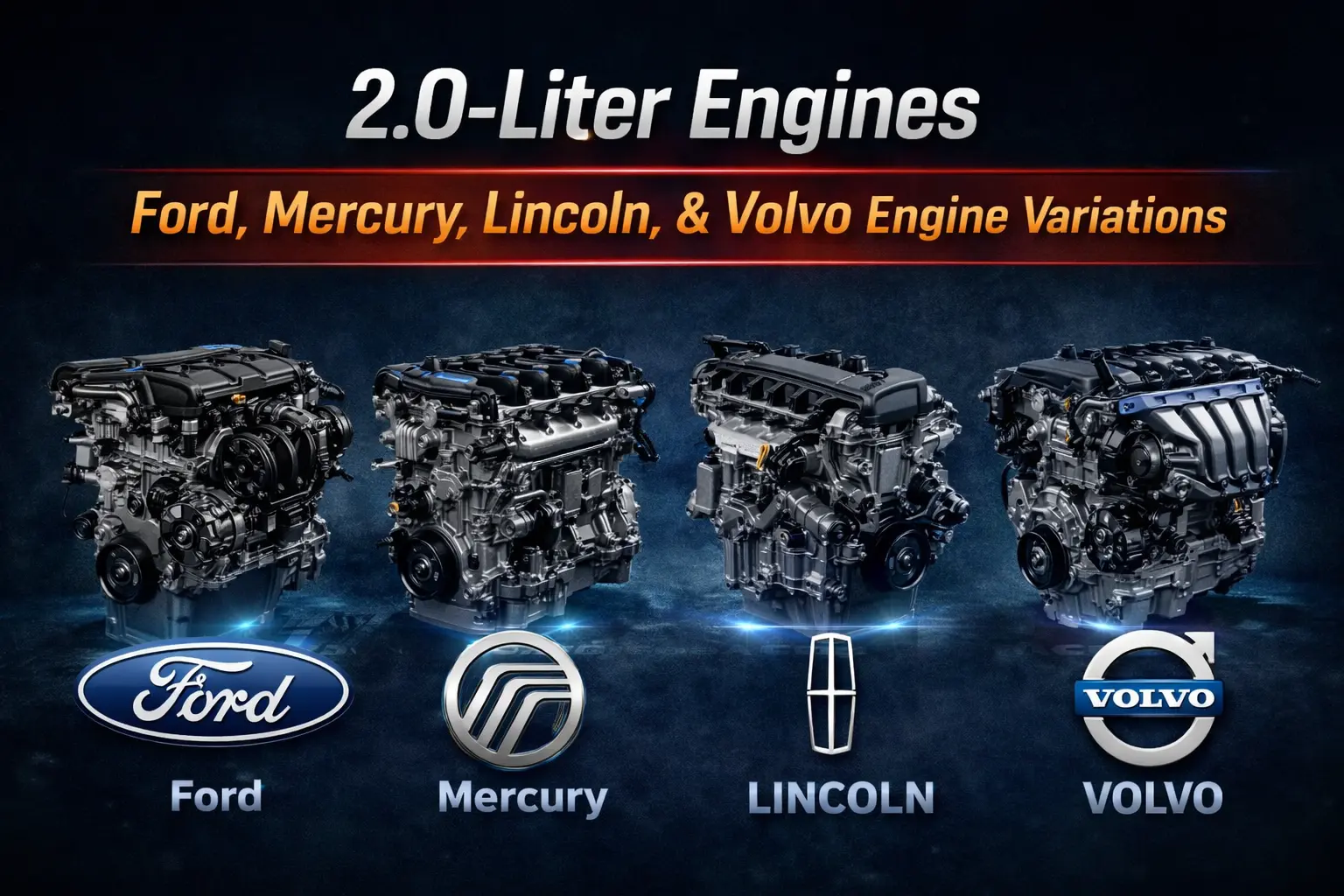
2.0-Liter Engines: The Zeta engine was introduced as a naturally aspirated upgrade to Ford’s earlier 1.8-liter engine, featuring a larger bore for improved performance and efficiency. Over time, Ford replaced the Zeta with the more advanced Duratec 2.0 engine. This evolution eventually led to the development of the first and second-generation EcoBoost GTDI engines, which use an inline four-cylinder design combined with turbocharging and direct fuel injection to deliver better power, fuel economy, and overall driving performance.
- 2.0 Zetec - This 2.0-liter Ford engine was designed to deliver a strong balance of power and reliability. It featured a 10.2:1 compression ratio, larger intake and exhaust valves, and Variable Valve Timing (VVT) technology to improve performance and fuel efficiency. Certain versions also came with a specially tuned performance ECU for enhanced horsepower and throttle response. Depending on the model and configuration, the engine produced between 128 and 170 horsepower. Ford used this engine in several popular vehicles, including the 1999–2002 Mercury Cougar, 1995–2000 Mercury Mystique, 1998–2003 Ford Escort, 2000–2004 Ford Focus, 2002–2004 Ford Focus SVT, 1995–2000 Ford Contour, and 2001–2005 Ford Escape.
- Duratec 20 - The 2.0L Duratec engine was built to provide a combination of solid performance, fuel efficiency, and long-term reliability. Depending on the vehicle application and production year, it featured either a 10.8:1 or 12.1:1 compression ratio and delivered between 136 and 166 horsepower. Produced from 2004 to 2018, this engine powered several popular Ford models, including the Ford C-Max, Ford EcoSport, Ford Fiesta ST, Ford Focus, and Ford Transit Connect. The Duratec 2.0 is also closely connected to Mazda’s L-series engine family, where it was known by names such as the 2.0 LF-DE, LF-VE, and LF-VD
- 2.0 EcoBoost (first generation) -
The 2.0-liter EcoBoost engine was engineered as a lightweight all-aluminum inline 4-cylinder turbocharged powertrain designed for strong performance and improved efficiency. It featured aluminum cylinder heads, high-pressure direct fuel injection, a 9.3:1 compression ratio, and Ford’s advanced Twin Independent Variable Camshaft Timing (Ti-VCT) system. Depending on the vehicle and tuning setup, this engine produced between 200 and 252 horsepower, with the highest-output version powering the 2012–2018 Ford Focus ST.
This versatile EcoBoost engine was used across a wide range of Ford, Lincoln, Land Rover, Range Rover, and Volvo vehicles, including the 2013–2015 Lincoln MKZ, 2015–2018 Lincoln MKC, 2011–2017 Range Rover Evoque, 2013–2015 Land Rover Freelander 2, 2015–2017 Land Rover Discovery Sport, 2012–present Volvo V40, 2010–2018 Volvo S60 and V60, 2011–2016 Volvo V70 and S80, 2011–2015 Ford Explorer, 2011–2014 Ford Edge, 2012–2016 Ford Falcon, 2013–2015 Ford Escape, 2013–2016 Ford Fusion, and 2013–2017 Ford Taurus.
- 2.0 EcoBoost (second generation) - The second-generation 2.0L EcoBoost engine was developed as a lighter and more refined version of the original EcoBoost design. It delivered improved performance and efficiency thanks to the addition of a twin-scroll turbocharger, along with upgraded fuel delivery and oil management systems. This newer engine also featured a higher 10.1:1 compression ratio for better power output and responsiveness. Depending on the vehicle application, the engine produced between 245 and 250 horsepower. It was used in several modern Ford and Lincoln models, including the 2016–present Lincoln MKZ, 2019 Lincoln MKC, 2019–present Lincoln Nautilus, 2020–present Lincoln Corsair, 2015–present Ford Edge, 2016–present Ford Escape, and 2021–present Ford Bronco.